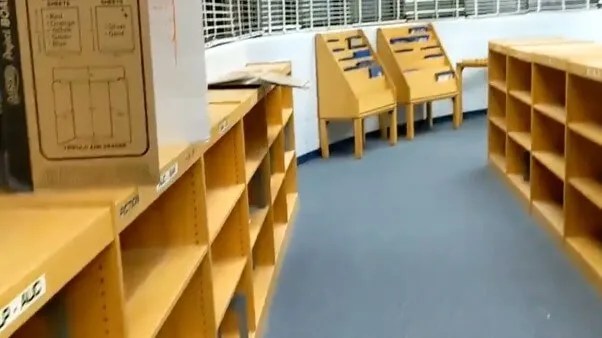
While proponents and opponents of the book bans wait for the August release of the list of nixed titles, books continue to be taken off the shelves in schools across the Sunshine State.
Months after Gov. Ron DeSantis called the schools book bans a “hoax” perpetrated by what he calls the liberal “Woke” contingent, the Florida Department of Education is preparing to release a list of books that have been removed from schools across the state.
But despite the Republican governor’s denials, all Florida school districts were required to submit to the Department of Education a list of materials that had been challenged due to its contents and had consequently been removed from school libraries or discontinued.
The list, which is meant to serve as a guide that districts can use when considering book purchases and material review, is set to be published by the end of August.
RELATED: Florida Second in Nation With Most School Books Banned
At the same time, opponents of the measure claim that because materials that are banned without a formal challenge are not required to be listed by schools, this could lead to an increase in books being banned without public input.
What Is the New Book-Challenge Law
Schools across the Sunshine State are grappling with HB 1069, a law that would require that all instructional materials selected for use in school districts be approved by the state Department of Education. It also seeks to make the process easier for people to object to instructional materials and library books that:
- Include “sexual conduct” from grades that are not age-suitable,
- prohibits the usage of pronouns that do not correspond to someone’s sex assigned at birth,
- bars classroom instruction on sexual orientation or gender identity from prekindergarten through grade 8, requiring all reproductive health materials be approved by the Department of Education and more.
But what, specifically, qualifies as “sexual content,” or “gender identity”? Opponents of the law are worried that its vague language could apply to valuable pieces of literature, from classics like Harper Lee’s “To Kill a Mockingbird” and Maya Angelou’s “I Know Why the Caged Bird Sings,” to the works of William Shakespeare.
“Overwhelmingly, we are seeing people Google ‘what books have LGBTQ content whatsoever,’ [and] even just a book that has an illustration of a same-sex interracial couple gets thrown onto one of these lists and ends up banned in some districts in Florida,” Jonathan Friedman, PEN America’s director of free expression and education programs said in a 2022 briefing.
RELATED: 1 In 8 Florida High School Seniors Won’t Attend a State School Due to DeSantis’s Education Policies
“Many teachers are reluctant to put any books up for the kids,” Sylvia Vera-Leon, a Miami-Dade County teacher, told Floricua. “They are having doubts and are very self-conscious about what books they have on their shelves. I know many who, if they have a classroom library, are actually boxing up their books.”
Other opponents of the law see the ban as the result of the state’s right-wing conservative turn.
“Did you see some of the pages that they are banning from math books [alleging they teach Critical Race Theory]? These books are nationally recognized books [that portray] history as it actually happened,” Congressmember Yvonne Hinson, who represents Florida’s District 20, told Floricua. “Why are they banning these books? Because they make the right-wing conservatives uncomfortable.”
The Ban Goes On
While proponents and opponents of the book bans wait for the August release of the list of banned titles, books continue to be taken off the shelves in Florida schools.
Recently, over 20 additional titles were added to the 23/24 list in Clay County schools alone, with one man reportedly having filed over 700 challenges in this district of 35K+ students.
“More books banned. More districts. More states,” PEN wrote in response to Florida’s ban. “More students are losing access to literature.”